
Remote tachograph
Downloading tachograph data is a legal obligation, not an option. With our units, driver cards and the vehicle mass memory download automatically, remotely, without taking anyone off the road.
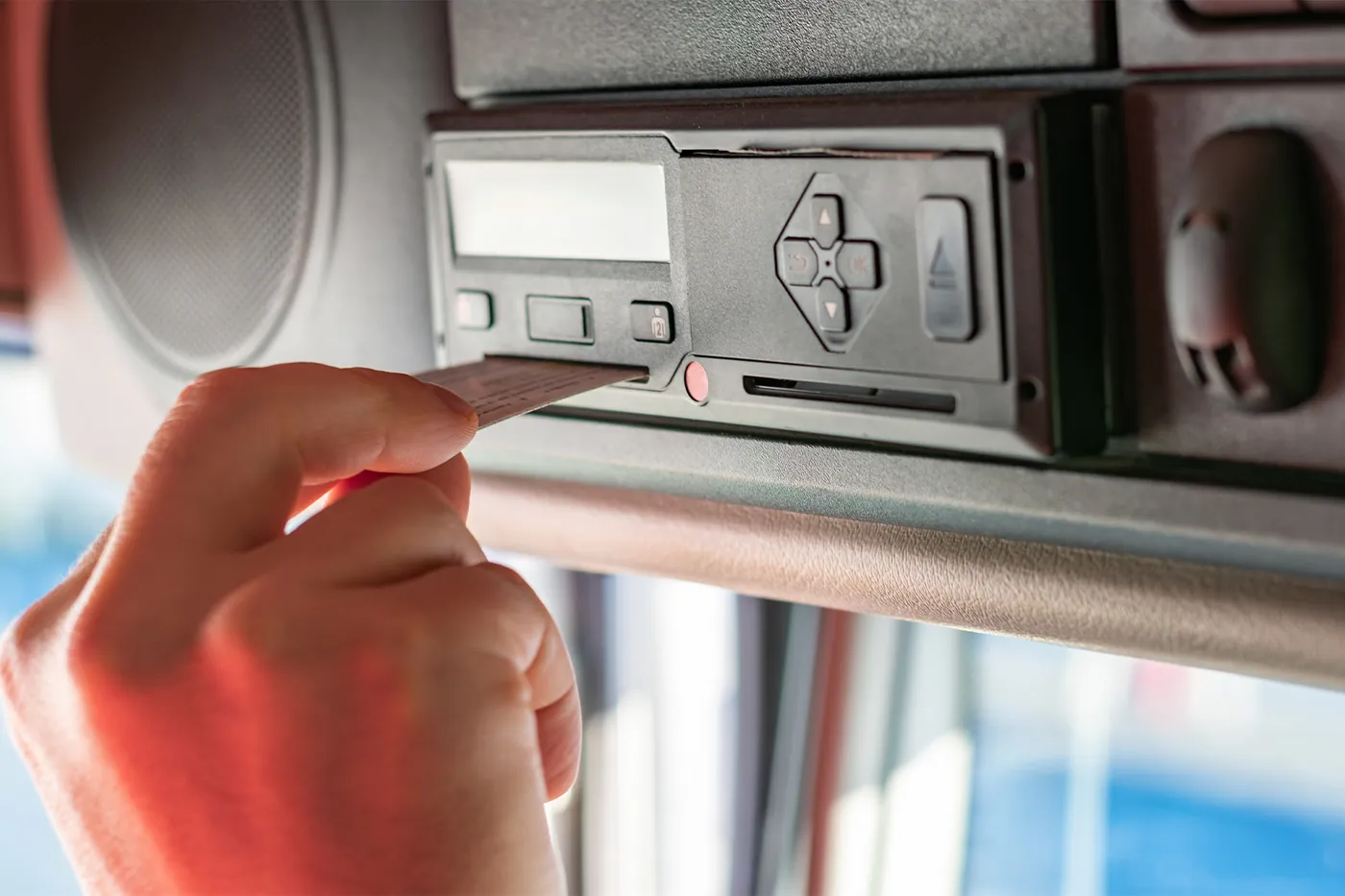
Downloading is not optional, forgetting is expensive
Regulation requires you to download tachograph data periodically: the driver card roughly every 28 days and the vehicle mass memory roughly every 90 days (intervals to be checked against the regulation in force). Miss one and you risk a fine.
Done by hand, every download keeps a vehicle standing still and ties up an operator with a download key. Driving and rest time overruns sometimes go unnoticed until the inspection. And the regulatory files end up scattered across USB sticks, e-mails and drives, hard to find on the day the inspection asks for them.
The smart tachograph v2 changes the game
The European Union's Mobility Package 1 made the second-generation smart tachograph mandatory across international transport: trucks completed their retrofit in 2025, and since 1 July 2026, light commercial vehicles over 2.5 tonnes in international transport are covered in turn (deadlines to be checked against the regulation in force and your type of transport).
In practice, that means more vehicles to download, more often, with the same staff. Remote downloading turns this obligation into a task that runs by itself.
The words often get mixed up. The analogue tachograph with its paper disc gave way to the digital tachograph, which writes to a driver smart card and to the vehicle mass memory. The smart tachograph is the generation after that: it adds satellite positioning and remote communication, in version 1 and then version 2. Our article on the smart tachograph v2 walks through the timeline step by step.
- Automatic download of driver cards, at the legal intervals
- Mass memory download, scheduled and archived
- Time-stamped archives, ready for an inspection or an audit
- Alerts if a download fails or a deadline is approaching
Remote tachograph download, in practice
Remote file download
The regulatory files are retrieved remotely, with no physical action on the vehicle, in the formats expected by the authorities and by analysis software: DDD, V1B, C1B, TGD.
Automated scheduling
You set a schedule per vehicle, per driver or at company level. The platform launches downloads at the right deadlines, without anyone having to think about it.
Company card registered
The company card is registered in the tachograph to authorise remote downloading. Once paired, the data comes in on its own, wherever the vehicle runs.
Central storage
Every file sits in one place and is reachable through the web interface, by e-mail or by FTP push to your driving time management software. Drive and rest states are followed in real time.
Trucks, vans and mixed fleets
Remote downloading is no longer a truck-only concern. Since vans over 2.5 tonnes in international transport have had to be equipped, companies that had never touched a tachograph are getting to grips with it.
Trucks and tractor units
Trucks, semi-trailer tractor units and rigids fitted with a digital or smart tachograph. The unit reads the CAN bus to the FMS standard (J1939) at the same time: driving times and real consumption land on the same dashboard.
Vans over 2.5 tonnes
Vans and panel vans carrying goods internationally. For these fleets everything is new: driver cards to manage, downloads to keep up with, files to archive. We set up the pairing and the schedule along with the unit.
Mixed fleets
A haulier rarely runs a single type of equipment. Trucks, vans and trailers are followed in the same place, each with its own reports. The detail by trade is on the transport and logistics page.
Tachograph terms, in plain words
Between the cards, the memories and the file formats, the jargon is dense. These are the terms that come up in our conversations with fleet offices; the telematics glossary defines the rest. The operation itself goes by remote download, remote tachograph download and DDD download alike: the same tachograph data, the same path from the vehicle to the server.
Digital tachograph
The device that records driving and rest times on a smart card and in the vehicle memory, instead of on the paper disc of the old analogue models. In the cab and in the workshop, everyone just says "the tacho".
Driver card
The driver's personal smart card. It identifies them on the device and carries the history of their activity. Remote downloading retrieves its data without taking it out of the reader.
Company card
The operator's card, registered in the tachograph. It is what authorises downloading and locks the vehicle's data so nobody else can read it.
Mass memory
The vehicle's internal memory. It keeps activities, detailed speeds and events over a rolling period, independently of the cards inserted. It is the second source of files to download, alongside the driver cards.
DDD files
The format of the data extracted from the tachograph. Depending on the device and the source of the data, the V1B, C1B and TGD extensions also appear. We archive them signed and time-stamped, readable by driving time analysis software.
Tachograph symbols
The current activity shows on the display as a pictogram: a steering wheel for driving, a bed for rest, two crossed hammers for other work, a square for availability. The platform carries those same states as text in its reports.
Figures worth keeping in mind
What you stop doing
Chasing trucks
No more bringing a vehicle back in or sending someone out with a download key. The unit takes care of it, wherever the vehicle is, and the vehicles stay on their runs.
Watching deadlines
The legal download intervals are met automatically. The dashboard shows at a glance what is up to date and what is approaching the limit.
Hunting for files
The regulatory files are archived, time-stamped and exportable. In case of an inspection, everything comes out in a few clicks, including into your driving time analysis software.
A fleet of thirty vehicles, zero trips
A haulier running thirty combinations in international transport used to lose an afternoon a month sending an operator round with a key, between the trucks present at the depot and the ones he had to wait for.
With scheduled downloads, the driver cards and the mass memory come in on their own at the right deadlines. A driving time overrun spotted early lets you re-plan a run before it becomes a fine, and the DDD files are ready to export on the day of the inspection.
- Driver card and mass memory download without a depot visit
- Driving and rest times available continuously
- Central regulatory archiving, exportable in one click
- Alerts for an approaching deadline or a missed download
Frequently asked questions
The questions that keep coming up about the tachograph and remote downloading. The other topics, anti-theft, installation and fleet, are in the general FAQ.
How do I download tachograph data remotely without stopping the truck?
The company card is registered in the tachograph to authorise remote downloading. Our units then retrieve the regulatory files over the mobile network, while the vehicle is driving or parked, with no operator travelling out and no key plugged in.
How often should I download the driver card and the mass memory?
In practice, you download the driver card roughly every 28 days and the vehicle mass memory roughly every 90 days. These intervals are to be checked against the regulation in force; the platform applies them automatically once the schedule is set.
Which file formats should I archive (DDD, C1B)?
The regulatory files come in DDD, V1B, C1B and TGD formats depending on the source of the data (driver card or vehicle memory). We keep them signed and time-stamped, ready for driving time analysis and for an inspection.
How do I automate tachograph compliance across a whole fleet?
You set a schedule per vehicle, per driver or at company level. Downloads launch at the deadlines, files are archived in one place and alerts warn you of any delay. Compliance becomes a background task rather than a monthly chore.
Are my vans over 2.5 tonnes covered by the smart tachograph v2?
If they carry goods internationally, yes: since 1 July 2026, they must be fitted with a smart tachograph v2. For purely national transport, the obligation does not apply in the same way. These deadlines are to be checked against the regulation in force; if in doubt, call us and we will go through your exact situation.
What is the difference between a digital tachograph and a smart tachograph?
The digital tachograph replaced the paper disc: it writes to the driver card and to the vehicle mass memory. The smart tachograph is the generation after that, with satellite positioning and remote communication, in version 1 and then version 2. The timeline of the move to v2 is set out in our article on the smart tachograph v2.
What do the tachograph symbols mean?
The device shows the current activity as a pictogram: steering wheel for driving, bed for rest, crossed hammers for other work, square for availability. On the platform, those same states appear as text in the per-driver reports, so there is no need to decipher the display in the cab. The other terms are defined in the telematics glossary.
Is remote downloading accepted during inspections?
Yes. European regulation explicitly provides for remote downloading of the data. What matters is meeting the intervals and keeping the signed files, which the platform does automatically. We also confirm each tachograph's compatibility before the offer.
Go further
Transport and logistics
Tachograph, driving time and cold chain for transport fleets.
DiscoverFleet management
Real-time tracking, CAN bus and integrated tachograph on a single platform.
Learn moreEco-driving
Driver score and fuel saved, from the same driving data.
Learn moreSmart tachograph v2
The Mobility Package timeline and vans over 2.5 tonnes.
Read the articleTelematics glossary
Driver card, mass memory, DDD file: the vocabulary defined.
ConsultPut the tachograph on autopilot
Tell us how many vehicles are affected and we will price the equipment and the remote download subscription.